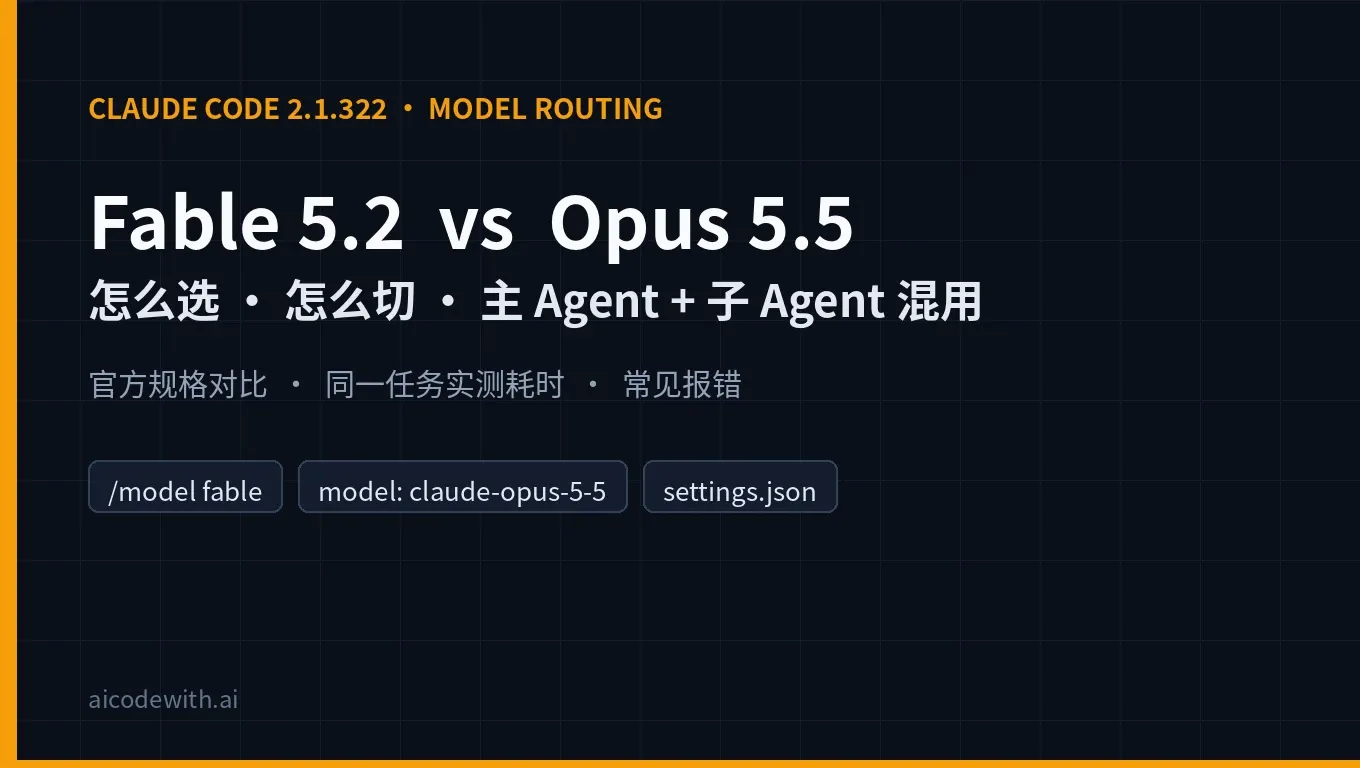
Claude Sonnet 5.5 vs Opus 5.5: which one should you pick? By Anthropic's official positioning, Sonnet 5.5 is strongest at well-scoped everyday tasks and bug fixes, while Opus 5.5 is aimed at complex work that calls for careful judgment. Anthropic says that in tests by its internal and external testers, Opus 5.5 is still clearly stronger on complex, open-ended tasks that require sustained judgment (Sonnet 5.5 official release page). This article only compares the specs, benchmarks, and pricing of these two models. To see how to split work between the main model and subagents in Claude Code, read "Which Model Should You Use in Claude Code". To compare the cheaper Haiku, read "Claude Haiku vs Sonnet".
Both models support a 1M context window and 128K max output for standard requests. Under current official pricing, Sonnet's input, output, cache write, and cache read rates are all half of the corresponding Opus rates. But their default thinking effort differs, so the actual amount of work done may differ too. Choose based on results that pass acceptance checks and on the full cost.
What's the difference between Sonnet 5.5 and Opus 5.5
Anthropic describes Sonnet 5.5 as a faster, lower-cost complementary option for well-scoped everyday work, and Opus 5.5 as the choice for complex, open-ended tasks that need sustained judgment. For any given coding job, both models are worth evaluating against real acceptance criteria.Sonnet official release notes
| Item | Sonnet 5.5 | Opus 5.5 |
|---|---|---|
| Claude API model ID | claude-sonnet-5-5 | claude-opus-5-5 |
| Context window | 1M Tokens | 1M Tokens |
| Max output per standard request | 128K Tokens | 128K Tokens |
| Input and output | Text and image input; text output | Text and image input; text output |
| API default effort | high | medium |
| Thinking mode | Adaptive by default; between_tools available | Adaptive always on |
| Official relative latency tier | Fast | Moderate |
For specs, see Sonnet model overview and Opus model overview. Fast and Moderate are official categories, not measured latency on any particular relay channel. Equal context capacity also does not prove equal retrieval accuracy.
Why official coding benchmarks can't name a winner
Below are three coding evaluations from the Sonnet 5.5 release announcement, keeping the comparisons listed by the same source. All figures are published by Anthropic:
| Benchmark | Sonnet 5.5 | Opus 5.5 | Conditions to keep in mind |
|---|---|---|---|
| Terminal-Bench 4.0 | 70.6% | 66.4% | The announcement notes Opus ran at xhigh, so this can't be treated as a head-to-head at a uniform effort |
| FrontierCode 1.1 Main | max 46.2%; xhigh 52.1% | 54.4% | Sonnet's two settings give different results, so you can't keep only the more favorable score |
| CursorBench 4.0 | 55.5% | 57.8% | A test on specific coding tasks; it can't be converted into a success rate for an arbitrary repository |
On Terminal-Bench, Sonnet scores higher, while in the other two rows Opus is higher. Concluding from any one of them that "Sonnet is stronger across the board" or that "Opus is required for all code" goes beyond what this data can support.
FrontierCode also offers a useful boundary. A footnote in the announcement explains that Sonnet at max more often invoked the code review workflow, and in some of the cases analyzed there were timeouts or changes outside the task scope, which is why its score was lower than at xhigh. Higher effort may produce more work, but it doesn't guarantee work that better matches the task.Official benchmarks and footnotes
For a real project, what needs verifying is this: did the model find the right evidence, do the changes respect interface constraints, do the tests pass, and did it introduce unrelated changes. A longer patch or a more detailed explanation is no substitute for these checks.
How to choose between everyday fixes and complex investigations
For everyday changes with clear tests, try Sonnet first
Examples include a reproduced boundary-value bug, adding a field to a single endpoint, a local refactor, or reviewing code against a fixed standard. First define which files may change, the public interfaces, and the acceptance command, then see whether Sonnet already meets the bar.
If the model didn't run tests, misread the error text, or changed too much, first check the task materials, tool permissions, and instructions. When the problem is missing files or a wrong environment, switching to a pricier model can't supply what's missing.
When the root cause is unclear or constraints are complex, add Opus to the comparison
Cross-service failures, complex migrations, and long-running refactors often require holding multiple hypotheses and constraints at once. Officially, Opus is positioned for this kind of sustained-judgment work, so you can test whether it reduces investigation rounds or manual rework under the same materials and acceptance conditions.
Don't assume that a higher price means higher reliability. Break the investigation into verifiable outcomes: evidence locations, how to reproduce, the proposed fix and its risks, the final change, and regression tests. Comparing how the two models do on these outcomes is more useful than looking only at the first answer.
| Task | Acceptance requirements to set first | Model differences worth watching |
|---|---|---|
| Reproduced bug | The original problem no longer appears and the new tests pass | First-pass success, unrelated diffs, time taken |
| Local refactor | Public interfaces and existing behavior stay consistent | Whether edge cases are missed, whether scope grows |
| Cross-module failure | Provides a root cause and evidence that can be re-checked | Investigation rounds, wrong hypotheses, time to correction |
| Complex migration | Compatibility conditions, failure handling, and rollback are verifiable | Whether it keeps honoring constraints, whether it misses dependencies |
How far apart current prices are, and what changed in cache pricing
The following are global standard direct API prices, in USD per million Tokens. The current standard 1M context for both models does not use Haiku 5.5's 100K pricing tier. Extra tools, special service tiers, taxes, and other platform charges are separate.
| Billing item | Sonnet 5.5 | Opus 5.5 |
|---|---|---|
| Standard input | $2 | $4 |
| Billed output | $10 | $20 |
| 5-minute cache write | $2.50 | $5 |
| 1-hour cache write | $4 | $8 |
| Cache read | $0.10 | $0.20 |
At Sonnet 5.5's launch, cache read was $0.20, the same as Opus. When Haiku 5.5 launched on October 7, Anthropic announced it was lowering Sonnet 5.5's cache read to $0.10. Prices in older launch posts need to be distinguished from the current documentation.Pricing change announcement, Current API pricing
What standard requests, cache creation, and cache hits each cost
Assume both models consume exactly the same billable usage, with no retries or extra tool fees:
| Scenario | Sonnet 5.5 | Opus 5.5 |
|---|---|---|
| 100K standard input + 20K output | $0.40 | $0.80 |
| 800K first-time 5-minute cache write + 100K standard input + 20K output | $2.40 | $4.80 |
| 800K effective cache read + 100K standard input + 20K output | $0.48 | $0.96 |
In the third row, Sonnet is 0.8 × $0.10 + 0.1 × $2 + 0.02 × $10 = $0.48; Opus is 0.8 × $0.20 + 0.1 × $4 + 0.02 × $20 = $0.96. The cost of building the cache the first time is paid separately. Don't leave it out of the overall task budget, and don't bill the same written Tokens again as standard input.
Official pricing vs. AICodeWith pricing at the same usage:
| Scenario | Model | Official price | AICodeWith price |
|---|---|---|---|
| 100K standard input + 20K output | Sonnet 5.5 | $0.40 | $0.076 |
| 100K standard input + 20K output | Opus 5.5 | $0.80 | $0.152 |
AICodeWith prices come from the pricing page, which as of 13:44 on October 15, 2026 showed these discounted prices: Sonnet 5.5 at $0.38 input / $1.90 output, and Opus 5.5 at $0.76 input / $3.80 output (per million tokens, USD).
View live AICodeWith pricing →
In these same usage scenarios, Sonnet costs half as much. Thinking, tool rounds, output, and retries on real tasks may differ, so the total cost of a full task is not guaranteed to be halved.
How Sonnet and Opus compare on the same channel
When using an API relay that supports multiple models, fix the channel before comparing. The figures below come from the October 9, 2026 version of the AICodeWith console model list's channel details, in USD per million tokens:
| Channel | Sonnet input / output | Opus input / output | Sonnet / Opus cache read | Sonnet / Opus cache write |
|---|---|---|---|---|
| Third-party Claude | $0.78 / $3.90 | $1.56 / $7.80 | $0.039 / $0.078 | $0.975 / $1.95 |
| Discount channel | $0.38 / $1.90 | $0.76 / $3.80 | $0.019 / $0.038 | $0.475 / $0.95 |
| Enterprise mixed pool | $1.30 / $6.50 | $2.60 / $13.00 | $0.065 / $0.130 | $1.625 / $3.25 |
These are prices displayed by the platform, not Anthropic's official direct-connect rates. The details page doesn't distinguish cache-write validity periods or all service conditions, so don't extend the prices in the table to contract prices for arbitrary requests. A listed catalog price also doesn't guarantee the channel is callable at that moment, so check the latest status and actual charges.
Will starting with Sonnet and upgrading to Opus save money?
Assume the discount channel, with each request using 100K regular input and 10K output. Sonnet costs 0.1 × $0.38 + 0.01 × $1.90 = $0.057, and Opus costs $0.114.
If Sonnet passes on the first try, the model cost is $0.057. If Sonnet fails twice and Opus then passes on one try, the model cost is 2 × $0.057 + $0.114 = $0.228, higher than the $0.114 you'd pay if Opus passed on the first try.
So an automatic escalation policy needs a stop condition. After one failure, check the cause first: if material is missing, add it; if the test environment is broken, fix it; only when the model has repeatedly misjudged and the evidence is complete should you consider switching models. Don't let a lower unit price become a reason for endless retries.
How effort and thinking affect the comparison
Sonnet 5.5 defaults to high in the Claude API and Opus defaults to medium; Sonnet's default in Claude Code and the Claude apps is medium again. A test must state the client, channel, and effort. "Both on default settings" is not the same condition.Sonnet release notes
Both models can use an explicit medium to establish a baseline, then test higher levels separately on hard tasks. Record billed output and total task time, not just how fast the first part of the answer arrives. An identical effort name still doesn't prove identical compute.
Sonnet can use thinking: {"type":"between_tools"} to turn off upfront thinking and accepts low, medium, and high; xhigh and max return an error. Progress in the form of thinking may still be returned between tool calls; with no tools, text is returned. This differs from Opus, which always has adaptive thinking on, so don't copy the configuration over directly.Sonnet migration guide
What to check before switching models and sessions
Both models use the Messages API, but a shared protocol doesn't mean any parameters or conversation history can be reused as is. Focus on checking:
- Tool choice: both reject forced any or specific tool modes. Use auto or other supported modes per the current docs, and validate tool calls at the application layer.
- Response parsing: read text from each block's
typeto get the text; don't assumecontent[0]is the answer; in tool loops, keep the corresponding thinking blocks as is. - Output budget:
max_tokenscovers both thinking and text. A short visible answer doesn't mean low output cost. - Session state: thinking blocks follow rules tied to the model, account, and history prefix. Don't assume that replaying across models or modifying old messages is valid.
When the application layer needs to upgrade models, after checking the completed changes you can compile the task facts, constraints, and failure evidence as input for a new session, then continue. This is a workflow suggestion, not a vendor's automatic migration mechanism; summaries may omit information and need to be checked against the repo and original records.
For specific parameters and retention rules, see the Sonnet and Opus migration guides. Support conditions for hosted agents, cloud platforms, and gateways need to be confirmed separately.
How to choose your team's default model
Start with a set of tasks that already have correct results or reliable tests, covering clear fixes, cross-file implementation, and complex investigation. Fix the repo version, input materials, tools, permissions, time limit, and retry budget; use a separate working copy and a fresh session each time. Alternate the run order, and keep results from default settings separate from those with explicit effort.
| What to record | What it tells you |
|---|---|
| First-pass and final pass | Distinguishes one-shot completion from multi-round patching |
| Unrelated diffs, interface regressions | Catches out-of-scope edits and hidden costs |
| Cost, cache, thinking output | Computes full model spend |
| Tool errors, refusals, model switches | Explains task interruptions and failures |
| Total time, manual fixes | Judges the interactive experience and team workload |
When comparing API cost, include failed attempts in the total, then divide by the number of accepted passes; if a group fails entirely, record that there were no passing results. Report manual correction time separately, and convert it to money only after you have real time figures and an explicit hourly-rate assumption.
Set default models by task type: let the low-cost route that meets requirements handle well-defined changes, and keep a separate route for hard investigations. Rerun regressions as the toolchain, models, or channels change, rather than treating the conclusion of one trial as permanent.
Hands-on comparison: setup and pricing reference
- You can compare the current channel prices for both models in the AI Code With model list, and see plans and top-up options on the pricing page.
- To assign Sonnet, Opus, and Haiku to Claude Code by task, see “How to Choose a Claude Code Model”.
- Before switching models in Claude Code, configure the Base URL and Key by following “Claude Code Third-Party API Setup Guide”, or refer directly to the Claude Code CLI docs.
- If you're still choosing between OpenAI and Anthropic, compare “GPT-6.1 Sol vs Claude Opus 5.5”.
- No account yet? First sign up for AI Code With, then run Sonnet 5.5 and Opus 5.5 separately with the same Key.
Conclusion
By official positioning, Sonnet 5.5 is for well-scoped everyday work and Opus 5.5 is for complex tasks that need sustained judgment (official Sonnet 5.5 announcement). Their current standard billing items have a clear 2x rate relationship (Sonnet overview, Opus overview), but task cost depends on actual usage and rework.
Fix the task and acceptance criteria first, then compare cost and full elapsed time. After choosing a default model, also set failure checks and escalation conditions, so the cheap route doesn't retry endlessly and not all work goes straight to the expensive route.
FAQ
Sonnet 5.5 scores higher on coding benchmarks, so why use Opus?
Sonnet has a higher Terminal-Bench score in the release table, but Opus scores higher on FrontierCode and CursorBench. Test setups and tasks differ, so you can't infer a universal winner from a single score.
Do both models charge the same for cache reads now?
No. Current official pricing is $0.10 per million tokens for Sonnet and $0.20 for Opus. Sonnet launched at $0.20, and that was cut on October 7. Include the date when you verify pricing.
Does a real task always cost only half as much on Sonnet?
You can calculate it that way when billed usage is the same and standard rates apply. If thinking, tool, and retry usage differ, the total bill can drift away from a clean half.
Does Opus have a larger context window than Sonnet?
Both 5.5 models officially support 1M context and 128K standard max output. Don't compare capacity alone. Test with real document retrieval and engineering tasks to see the difference.
Can I use between_tools with Opus 5.5 directly?
No. Don't copy the Sonnet rules over. Opus always runs with adaptive thinking on. For Sonnet, configure between_tools and the applicable effort levels according to its own model documentation.
Sources and Further Reading
- Sonnet 5.5 official release notes: task positioning, coding benchmarks, settings, and footnotes.
- Sonnet 5.5 official overview: specs, default effort, and current pricing.
- Opus 5.5 official overview: specs, thinking behavior, and current pricing.
- Anthropic's current API pricing: rules for caching, Batch, and long context.
- October 7 cache pricing announcement: Sonnet cache reads dropped from $0.20 to $0.10.
- Sonnet 5.5 migration guide: between_tools, tool selection, and response parsing.
- Opus 5.5 migration guide: always-on thinking and session retention requirements.