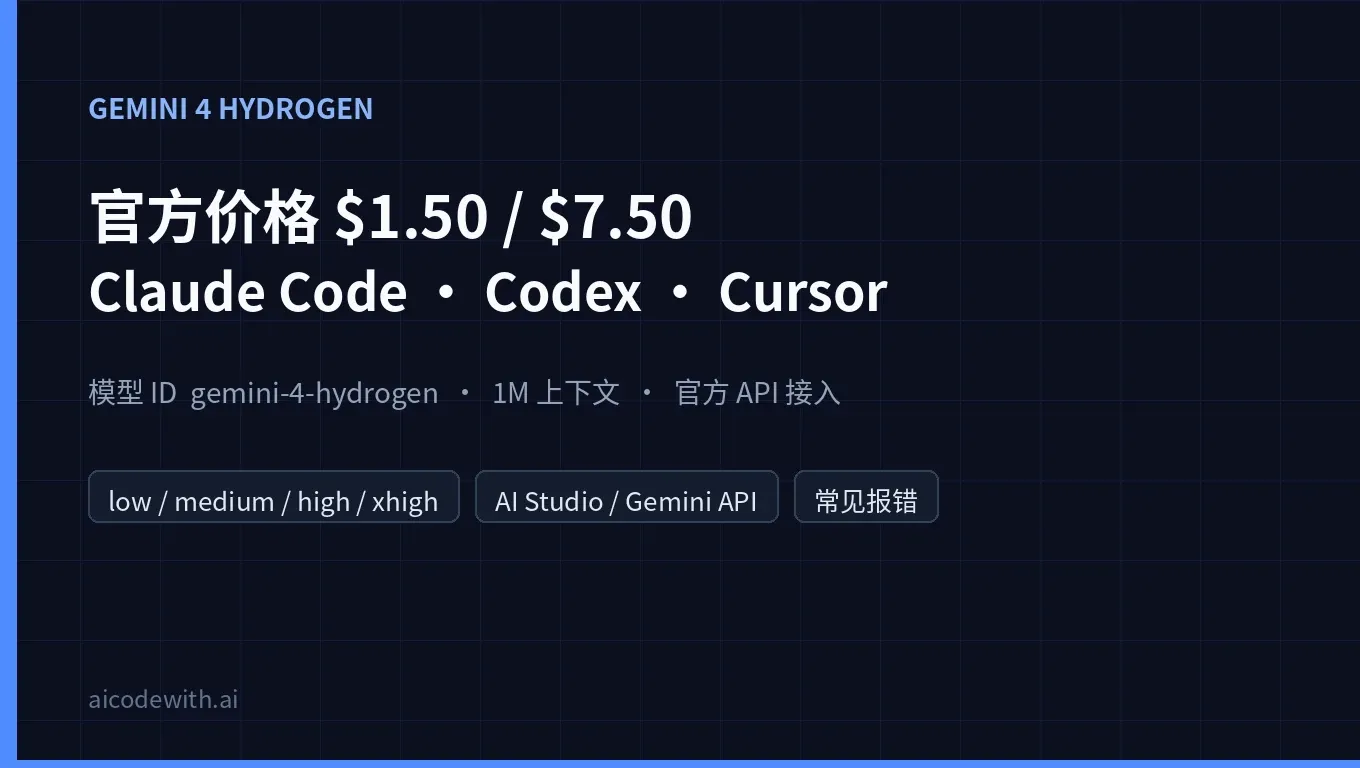
Gemini 4 Hydrogen is Google's efficiency model for everyday coding and agentic workflows. According to the official Google blog (Koray Kavukcuoglu, 12 November 2026), it launched that day in US time, which is about 02:02 on 13 November 2026 in Beijing time. The official model ID is gemini-4-hydrogen, the context window is 1M, and official Gemini Developer API standard pricing is $1.50 per million input tokens and $7.50 per million output tokens (including thinking tokens). Long-horizon frontier reasoning remains with Gemini 4 Carbon and Gemini 4 Argon.
On 13 November 2026 (Beijing time, UTC+8), we checked this site's public model catalog and https://api.aicodewith.ai/v1/models. The list already included gemini-4-carbon, gemini-4-argon, gemini-3.8-flash, and gemini-3-flash-preview, and it did not yet include gemini-4-hydrogen or a clearly equivalent model ID. With a test key, we sent one request to each of this site's three common endpoints; all three returned HTTP 400 with the message that the model gemini-4-hydrogen does not exist or is not online. This test machine did not have an official Gemini API key, so we did not run a call against the official Gemini API. We also did not run a Hydrogen task in Claude Code, Codex, or Cursor. Below we first follow official docs for AI Studio and the Gemini API, then show how already-listed Gemini models are configured in the three clients. When the catalog shows gemini-4-hydrogen, change the model name to that ID.
Quick takeaways
| Question | Answer |
|---|---|
| What is Hydrogen? | Google's efficient Gemini 4 model for everyday coding and agentic workflows. Carbon and Argon remain the long-horizon frontier models. |
| Model ID | gemini-4-hydrogen |
| Official standard price (per 1M tokens, USD) | Input $1.50; output (including thinking tokens) $7.50; implicit cache $0.075. Explicit caching is not supported. |
| Free tier | The official pricing page marks input, output, and implicit caching as Free of charge. Search / Maps grounding is not available on the free tier. |
| Context and output | 1M context. The official models page lists Max output 65K / 1M tokens. The model card says default synchronous output is up to 64K, with background long decode up to 1M. |
| Thinking levels | Officially low, medium, high (default), plus the new xhigh level. |
| How do you connect it now? | Use official AI Studio or the Gemini API, and set the model name to gemini-4-hydrogen. This site's catalog did not yet list this model ID at the time of this run. The Gemini models already listed here are Carbon, Argon, and 3.8 Flash, among others. |
What is Gemini 4 Hydrogen?
According to the official launch blog and the developer announcement:
- Hydrogen is positioned to bring Gemini 4-class intelligence to more everyday coding and agentic workflows, with an emphasis on speed and efficiency.
- Carbon and Argon are still used for the hardest long-horizon reasoning. Hydrogen can stand on its own for everyday execution, or serve as the high-efficiency engine in multi-model workflows.
- Google is also introducing Orchestrator in Antigravity, which switches between Carbon and Hydrogen in the same session. Google says that on Terminal-Bench 4.0, Orchestrator reached near-Carbon task success rates while, on average, using 24% less quota and finishing 19% faster.
- Availability: all Google AI Studio tiers, the Gemini API, Gemini for business, the Gemini app, Google Search, and paid Google AI Pro / Ultra subscribers in Google Antigravity. Free users of the Gemini app get Hydrogen through auto model selection when it is the right model for the prompt.
- You can try it directly in AI Studio. Fuller safety and evaluation notes are in the official Gemini 4 Hydrogen model card (published 12 November 2026). The model card also states a knowledge cutoff of March 2026, with some domains possibly older.
@GoogleDeepMind, @GeminiApp, and @GoogleAIStudio announced the launch on the same day. According to 9to5Google, the Gemini app model picker labels 4 Hydrogen as Everyday help.
Specs at a glance
The table below is compiled from the official models page, pricing page, thinking-level docs, and model card. Use the official text as the source of truth.
| Item | Official description |
|---|---|
| Model name | Gemini 4 Hydrogen |
| Gemini API model ID | gemini-4-hydrogen |
| Context | 1M tokens |
| Max output | Official models page: 65K / 1M tokens. Model card: up to 64K default synchronous output, and up to 1M via background long decode. |
| Input modalities | Text, Image, Audio, Video, PDF |
| Thinking levels | low, medium, high (default), xhigh (new on Hydrogen; Carbon / Argon use low / medium / high) |
| Caching | Implicit caching only; explicit caching is not supported |
| Free tier | Available. The pricing page marks input, output, and implicit caching as Free of charge. Grounding is not available on the free tier. Free-tier content may be used to improve Google's products; paid-tier content is not, according to the official pricing page. |
Official pricing
The official Gemini Developer API pricing page is in USD per million tokens. The numbers below are Hydrogen's standard prices. Do not mix them up with Gemini 3.8 Flash at $0.75 / $3.75, which the official page says is valid through 31 December 2026.
| Item | Free tier | Paid tier (per 1M tokens, USD) |
|---|---|---|
| Input | Free of charge | $1.50 |
| Output (including thinking tokens) | Free of charge | $7.50 |
| Context caching | Free of charge | $0.075, implicit caching only; explicit caching is not supported |
Paid-tier Grounding with Google Search / Maps: Gemini 3 and newer models share 5,000 free requests per month, then $14 per 1,000 requests. Search grounding is also subject to a daily cap of 1,500 requests. Official note: a single user request may trigger more than one search, and you are charged for each query. The pricing page also states that every token the model processes is counted and billed, including thinking tokens and internal tool system instructions and function declarations when using grounding.
This site's catalog did not yet list gemini-4-hydrogen at the time of this run. The Gemini models already listed at the same time were gemini-4-carbon, gemini-4-argon, gemini-3.8-flash, and gemini-3-flash-preview. Client setup for those IDs is below.
Official benchmarks
The figures below all come from Google's launch blog and model card. They are not our own reruns. Test setups may differ from third-party evaluations, so treat them as official claims.
According to the official blog:
- Artificial Analysis Intelligence Index: 51 at the default high setting, versus 50 for Argon; 54 at xhigh.
- At default high, it finishes tasks 2.5 times faster than Gemini 3.8 Flash.
- Terminal-Bench 4.1: 57%, versus 18.2% for 3.8 Flash.
- Google says fabricated claims dropped by more than 5x.
- On Terminal-Bench 4.0, Antigravity Orchestrator reached near-Carbon success rates while, on average, using 24% less quota and finishing 19% faster.
The blog also mentions a #5 rank on Agent Arena, 58.8% on HLE-Diamond, 52.3% on Vals Tax Agent Bench, 55.8% on Vals Legal Research Bench, and 53.4% on Multimodal Knowledge Agent (MKA). The fuller comparison tables are in the model card and the evaluation methodology.
Connect it with the official Gemini API or AI Studio
This is the path that can use Hydrogen today. The steps follow the official quickstart, thinking-level docs, and What's new. We did not run these commands with an official key.
- Create an API key in Google AI Studio, or open a Hydrogen chat first.
- Install the official SDK:
google-genaifor Python, or@google/genaifor JavaScript. Put the key in theGEMINI_API_KEYenvironment variable. - Set the model name to
gemini-4-hydrogen. The current official Interactions API example looks like this.
Python:
from google import genai

client = genai.Client()

interaction = client.interactions.create(
    model="gemini-4-hydrogen",
    input="Explain how AI works in a few words."
)
print(interaction.output_text)
REST, as shown in the official quickstart:
curl -X POST "https://generativelanguage.googleapis.com/v1beta/interactions" \
  -H "x-goog-api-key: $GEMINI_API_KEY" \
  -H "Content-Type: application/json" \
  -H "Api-Revision: 2026-05-20" \
  -d '{
    "model": "gemini-4-hydrogen",
    "input": "Explain how AI works in a few words"
  }'
Thinking depth is controlled with generation_config.thinking_level. The official default is high. For harder multi-step coding and agent tasks you can set xhigh; for latency- and token-sensitive work, use low or medium. Official docs warn that using xhigh on simple text or JSON extraction can overthink the task or exhaust max_output_tokens. The Python form in the docs is:
from google import genai

client = genai.Client()

interaction = client.interactions.create(
    model="gemini-4-hydrogen",
    input="Audit this payment retry queue for race conditions and rewrite the lock acquisition logic.",
    generation_config={
        "thinking_level": "xhigh"
    }
)
print(interaction.output_text)
Using it in Claude Code, Codex, and Cursor
The three clients are listed side by side; use the one you already work in. This site's catalog did not yet include the gemini-4-hydrogen model ID at the time of this run, so the config below should not be read as a successful Hydrogen run in those clients. It applies to Gemini models already listed here. When the catalog shows gemini-4-hydrogen, change the model name to that ID. For Codex fields, see Codex API key config and the Codex config.toml guide. For Claude Code, see Claude Code third-party API setup.
What we actually observed:
GET https://api.aicodewith.ai/v1/modelsreturned 61 models. The Gemini IDs weregemini-4-carbon,gemini-4-argon,gemini-3.8-flash, andgemini-3-flash-preview. Hydrogen was not in the list.- The public site catalog also did not include Hydrogen.
- We sent a minimal request with
modelset togemini-4-hydrogentohttps://api.aicodewith.ai/v1/chat/completions,https://api.aicodewith.ai/chatgpt/v1/chat/completions, andhttps://api.aicodewith.ai/v1/messages. All three returned HTTP 400 in about 0.1 to 0.2 seconds, with the message that the modelgemini-4-hydrogendoes not exist or is not online, and a pointer tohttps://aicodewith.ai/zh/dashboard/pricing.
Claude Code uses ~/.claude/settings.json. At launch, specify a model already listed here, for example gemini-4-argon:
{
  "env": {
    "ANTHROPIC_BASE_URL": "https://api.aicodewith.ai",
    "ANTHROPIC_AUTH_TOKEN": "your AICodeWith API Key"
  }
}
claude --model gemini-4-argon -p "Reply with exactly: pong"
Codex uses ~/.codex/config.toml. The base_url must be https://api.aicodewith.ai/chatgpt/v1, not /v1. Use a global experimental_bearer_token, and set name to "aicodewith":
model_provider = "aicodewith"
model = "gemini-4-argon"

[model_providers.aicodewith]
name = "aicodewith"
base_url = "https://api.aicodewith.ai/chatgpt/v1"
wire_api = "responses"
experimental_bearer_token = "your AICodeWith API Key"
codex exec --skip-git-repo-check "Reply with exactly: pong"
In Cursor, you can enter a custom API and model name in the model settings. We did not run this path, so whether it connects depends on your local Cursor version. When Hydrogen appears in the catalog, the model name is likewise gemini-4-hydrogen.
If you want the official Gemini-native protocol, this site's docs give a base URL of https://api.aicodewith.ai/gemini_cli, with requests of the form POST https://api.aicodewith.ai/gemini_cli/v1beta/models/{model}:generateContent, authenticated with Authorization: Bearer plus your key from this site. That path can also only use Gemini model IDs already in the catalog; you should not expect {model} to work as gemini-4-hydrogen today.
If you want to use other Gemini models on this site first, or switch the model name later when Hydrogen is listed, start by creating an API key.
Common errors and fixes
| Error / symptom | Cause | Fix |
|---|---|---|
| 模型 gemini-4-hydrogen 不存在或未上线 (HTTP 400) | This site's catalog does not list that model ID yet (we hit this on 13 November 2026) | Check this site's model list or pricing page. To use Hydrogen now, go through official AI Studio / the Gemini API. On this site, you can already use gemini-4-argon, gemini-4-carbon, or gemini-3.8-flash. |
| Codex says the model does not exist, but the ID is already listed | base_url was set to https://api.aicodewith.ai/v1 | Change it to https://api.aicodewith.ai/chatgpt/v1 |
| Official SDK or curl returns 400 / 403 | Missing or wrong key, or the request did not hit the official Gemini endpoint | Confirm the environment variable is GEMINI_API_KEY, send REST calls to https://generativelanguage.googleapis.com/v1beta/interactions, and include x-goog-api-key |
| A key from this site is sent to official generativelanguage.googleapis.com, or an official Gemini key is sent to this site | The two credentials and the two endpoints are not interchangeable | Official keys are only for Google's API. Keys from this site are only for api.aicodewith.ai |
| Output is truncated, or a simple extraction job is slow and long | thinking_level was set to xhigh, or max_output_tokens is too small | Follow the official docs: use low or medium for simple tasks, and give max_output_tokens enough room |
| A Gemini-native request sent to /v1/chat/completions does not behave as expected | This site's native Gemini protocol uses /gemini_cli, and should not be mixed with the OpenAI-style entry | When you need generateContent, use the base URL https://api.aicodewith.ai/gemini_cli |
FAQ
How should I choose among Hydrogen, Carbon, and Argon?
According to the official blog: for everyday coding, tests, and fast repository edits, start with Hydrogen; for the hardest long-horizon reasoning and architectural judgment, stay with Carbon or Argon. Google also presents Hydrogen as the main everyday upgrade from Gemini 3.8 Flash. For more comparison, see the Gemini 4 Carbon review and Gemini 4 Argon review.
The official price is $1.50 / $7.50. Is that the same as 3.8 Flash?
No. Hydrogen's paid standard price is $1.50 per million input tokens and $7.50 per million output tokens. Official Gemini 3.8 Flash pricing is currently $0.75 / $3.75 through 31 December 2026, and $1.50 / $7.50 after that. Always match the numbers to the model ID on the pricing page.
Can I select Hydrogen directly in Claude Code or Codex today?
Yes if you go through the official Gemini API or AI Studio, using the model name gemini-4-hydrogen. Through this site's API, the catalog did not yet list that model ID at the time of this check, and forcing the name returns the HTTP 400 above. This site already lists Carbon, Argon, and 3.8 Flash.
Is there a free tier?
According to the official pricing page, Hydrogen's free tier includes input, output, and implicit caching, marked Free of charge. Search / Maps grounding is not available on the free tier. Free-tier rate limits follow whatever Google publishes at the time, and free-tier content may be used to improve Google's products.