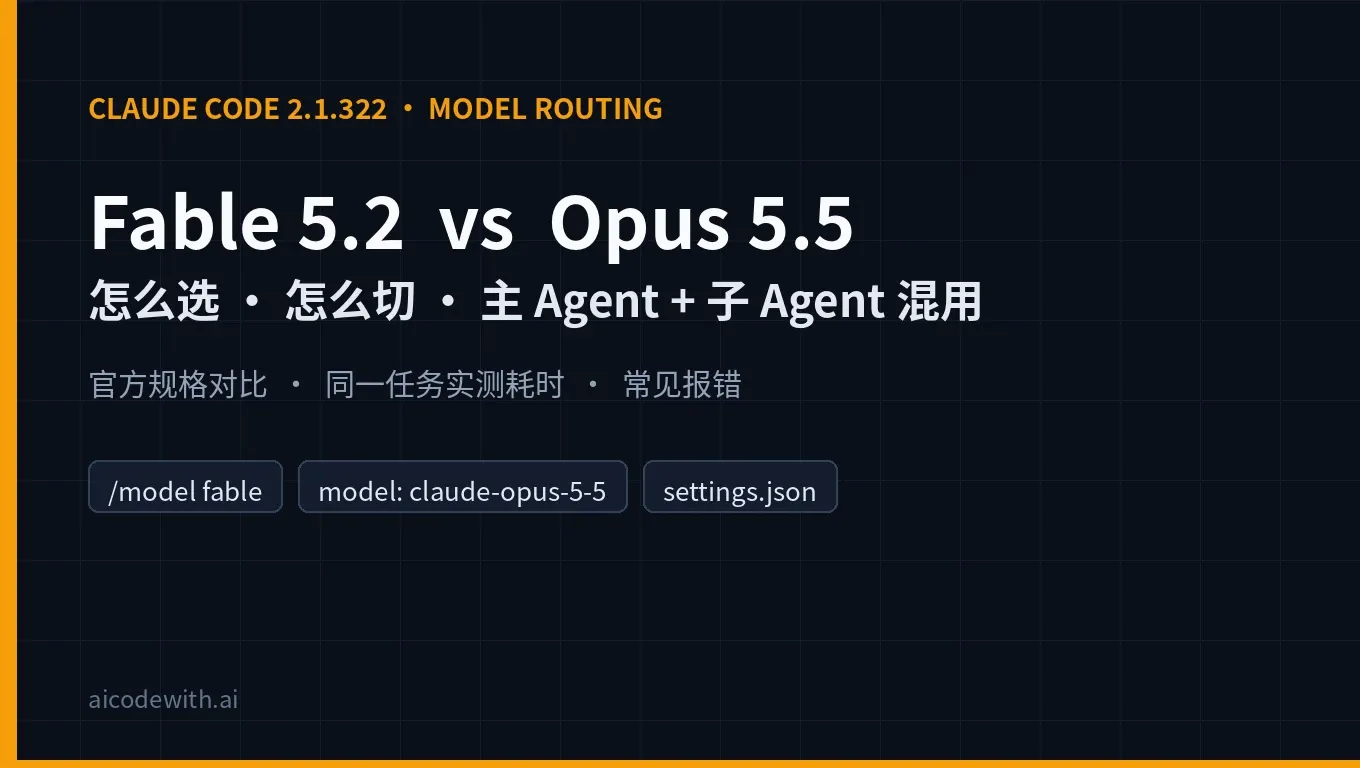
If you already have an OpenAI Responses or Codex workflow and want to control model costs for complex coding, start by testing GPT-6.1 Sol. If you already maintain Claude Code or an Anthropic Messages tool loop, start by evaluating Claude Opus 5.5. The two models start from different places, so the final comparison should look at the result on the same task, the total call cost, and the time spent on manual fixes.
At official standard pricing, GPT-6.1 Sol's input and output rates are half those of Opus 5.5. But long context changes that ratio, and third-party channels may apply different discounts. Whether a complete task is cheaper also depends on thinking output, tool calls, and failed retries.
This article was verified on October 9, 2026, based on official model, pricing, and migration docs, plus the AICodeWith channel data displayed that day. I did not run independent performance tests or paid API head-to-head comparisons of the two models. The cost examples are hypothetical calculations, and the task recommendations are meant to help you decide the order of testing.
What are the main differences between GPT-6.1 Sol and Opus 5.5
OpenAI positions GPT-6.1 Sol for complex coding, computer use, and professional work. Anthropic positions Opus 5.5 for long-running coding agents and knowledge work. Their public positioning overlaps, but the interfaces and billing rules differ clearly.
| Comparison | GPT-6.1 Sol | Claude Opus 5.5 |
|---|---|---|
| Official model ID | gpt-6.1-sol | claude-opus-5-5 |
| Context window | 1,050,000 tokens | 1,000,000 tokens |
| Max output per standard request | 128,000 tokens | 128K tokens |
| Input and output | Text and image input; text output | Text and image input; text output |
| Tool-calling interface | OpenAI Responses API | Anthropic Messages API |
| Reasoning control | reasoning.effort | output_config.effort |
| Available effort levels | low, medium, high, xhigh, max | low, medium, high, xhigh, max |
| Default effort | medium | medium |
| Thinking limits | none and minimal not supported | Adaptive thinking always on |
Specs are based on the OpenAI model page, GPT-6 usage guide, and the Opus official overview. Both sides call a level medium, but that doesn't mean the compute, latency, or output length are the same.
Similar context capacity also doesn't prove that the two models are equally accurate at finding the key files in a large repository. You should still check citations, omissions, tool execution, and test results. Reading an image and returning text is a different capability from natively generating images.
Which model to test first for which coding tasks
Plan your tests around your existing workflow and acceptance criteria, rather than switching based on a "flagship" or "low-price" label.
| Your task or environment | Suggested test order | What to verify |
|---|---|---|
| Existing Responses toolchain or Codex workflow | Use Sol to set the baseline first | Whether tool calls, patches, and existing tests work normally |
| Existing Claude Code or Messages tool loop | Evaluate Opus 5.5 first | Whether the new thinking behavior, tool selection, and conversation history are compatible |
| Small-scope fix with a clear reproduction and tests | Put both models through the same set of samples | First-pass success, unrelated changes, retry cost |
| Cross-module failures, architectural constraints, or long-running refactors | Run sustained-task regression on both | Whether the evidence is correct, whether constraints keep being followed, whether the changes drift further off course |
| Bug reports mixing text and images | Use the same images, files, and acceptance requirements | Whether the extracted information is correctly tied to the code and the fix |
This table is a testing guide, not a ranking of model capability. An existing toolchain's advantage is fewer integration variables. It doesn't prove the model you already use will win on task quality.
For a well-scoped fix, pin down a single problem: "Fix this boundary-value bug without changing the public interface, and make both the original tests and the new regression test pass." For architecture tasks, spell out throughput, compatibility, the modules you allow to change, and rollback conditions. If the task has no acceptance criteria, comparing the writing style of two answers won't give you a reliable choice.
How much do the official API prices differ
Below are the global standard direct-access model prices, in USD per million tokens. Sol's base price applies to requests with input of 272K or less. Fast mode, regional processing, extra tool fees, and taxes are charged separately.
| Billing item | GPT-6.1 Sol standard tier | Opus 5.5 standard tier |
|---|---|---|
| Regular input | $2 | $4 |
| Output | $10 | $20 |
| Cache read | $0.10 | $0.20 |
| Cache write | $2.50 | 5 minutes $5; 1 hour $8 |
Sol's base rates for input, output, and cache reads are all half of Opus's. Cache writes have to be compared under the specific terms, and you can't merge different retention periods into one item.OpenAI API pricing, Anthropic API pricing
Same billable usage: what one request costs on each
Assuming identical billable usage, with no extra tools, fast mode, retries, or cache creation fees:
| Billable usage | GPT-6.1 Sol | Opus 5.5 |
|---|---|---|
| 100K regular input + 10K output | 0.1 × $2 + 0.01 × $10 = $0.30 | 0.1 × $4 + 0.01 × $20 = $0.60 |
| 200K cache read + 20K regular input + 10K output | 0.2 × $0.10 + 0.02 × $2 + 0.01 × $10 = $0.16 | 0.2 × $0.20 + 0.02 × $4 + 0.01 × $20 = $0.32 |
The second row assumes the cache is already built and this request actually hits it, and it excludes the earlier write cost. The same text and the same task can produce different token counts and numbers of call rounds on the two models, so this table shouldn't be treated as an actual task bill.
Once Sol's input passes 272K, the cost ratio changes
OpenAI specifies that when Sol's prompt input exceeds 272K tokens, the input and cache rates for the entire request double, and the output rate becomes 1.5 times the standard rate. The surcharge isn't applied only to the portion over the threshold. Anthropic currently doesn't apply this kind of tier rule to Opus 5.5's standard 1M context.
For example, with 300K of regular input and 10K of output, Sol is calculated at $4 / $15, for a cost of 0.3 × $4 + 0.01 × $15 = $1.35. Opus's standard cost is 0.3 × $4 + 0.01 × $20 = $1.40. In this fixed-usage example the two are close, so you can no longer say Sol's total cost is only half.
How channel pricing changes your selection budget
If you compare the two through an API relay that supports multiple models, confirm which channel you are actually using. The following are the prices shown in the AICodeWith console model list on the verification date, in USD per million tokens. The original channel names are kept so you can check them against the dashboard:
| Model and channel | Input | Output | Cache read | Cache write |
|---|---|---|---|---|
| Sol: codex subscription channel | $0.20 | $1.00 | $0.010 | $0.25 |
| Sol: codex subscription channel Pro | $0.22 | $1.10 | $0.011 | $0.275 |
| Opus: special-offer channel | $0.76 | $3.80 | $0.038 | $0.95 |
| Opus: third-party claude | $1.56 | $7.80 | $0.078 | $1.95 |
| Opus: enterprise mixed pool | $2.60 | $13.00 | $0.130 | $3.25 |
These are channel list prices on the platform, not official quotes. "codex subscription channel" is a channel name in the console, and it should not be read as a fixed token quota you get from buying a ChatGPT subscription yourself. For long context, cache lifetime, service tiers, and extra fees that the page does not spell out, check the contract for the specific channel instead of deriving them from the discount.
Compare identical short requests first, then price the whole task
Assume the list prices above and a single request with 100K regular input tokens and 10K output tokens, with no caching and no extra fees:
| Channel | Assumed model cost per request |
|---|---|
| Sol: codex subscription channel | $0.030 |
| Sol: codex subscription channel Pro | $0.033 |
| Opus: special-offer channel | $0.114 |
| Opus: third-party claude | $0.234 |
| Opus: enterprise mixed pool | $0.390 |
The regular Sol channel works out to 0.1 × $0.20 + 0.01 × $1 = $0.03; the Opus special-offer channel works out to 0.1 × $0.76 + 0.01 × $3.80 = $0.114. For this combination, the per-request cost differs by 3.8x, which shows that channel discounts can change the official two-to-one price relationship.
If we further assume Sol uses exactly the same amount on every attempt, three attempts cost $0.09 and four cost $0.12, while one Opus attempt costs $0.114. This only shows that retries after failures can cancel out a lower unit price. It does not mean either model actually needs that many attempts. In a real multi-turn task, context, cache, and output change from turn to turn, so add up the cost turn by turn.
Also check list price and actual availability separately. At the time of verification, the "available" label in the Opus catalog did not match the stats for some channels, and the special-offer channel's current data point showed 0% availability. This is not a success rate measured in this article, and it does not mean the model is unavailable long term. Still, a budget should not treat a static list price as a guarantee that calls will work. Before integrating for real, check the channel's current status and run your own acceptance requests.
Why you can't just swap the model ID when integrating
GPT-6.1 Sol needs Responses for tool calls
According to the official documentation, Sol uses tool calls through the Responses API, while Chat Completions supports requests without tools. If an existing agent relies on a Chat Completions tool loop, you can't just replace the model; you also need to adjust the request, how tool results are sent back, and response parsing.
Set reasoning with reasoning.effort, which supports five levels from low to max. none and minimal are not supported. For the specific parameters, see the official GPT-6 usage guide; check the gateway's supported range separately.
Opus 5.5 needs to work with always-on thinking
Opus 5.5 does not accept disabling thinking or the old manual budget_tokens form. Use adaptive thinking with output_config.effort. Tool choice supports auto and none; forcing any or a specific tool returns an error.
When parsing responses, read text by each block's type field, and don't assume the first block is the answer. In tool loops, keep thinking blocks exactly as returned; max_tokens covers both thinking and text. The thinking text returned by default may be empty, so a UI that shows no progress yet doesn't mean the request is stuck.Opus 5.5 migration guide
The two protocols differ in tool schema, messages, and session state. When you switch models, build requests with the matching client and handle each side's tool results. A unified account or API key doesn't turn the two interfaces into the same protocol.
How to run a meaningful coding comparison
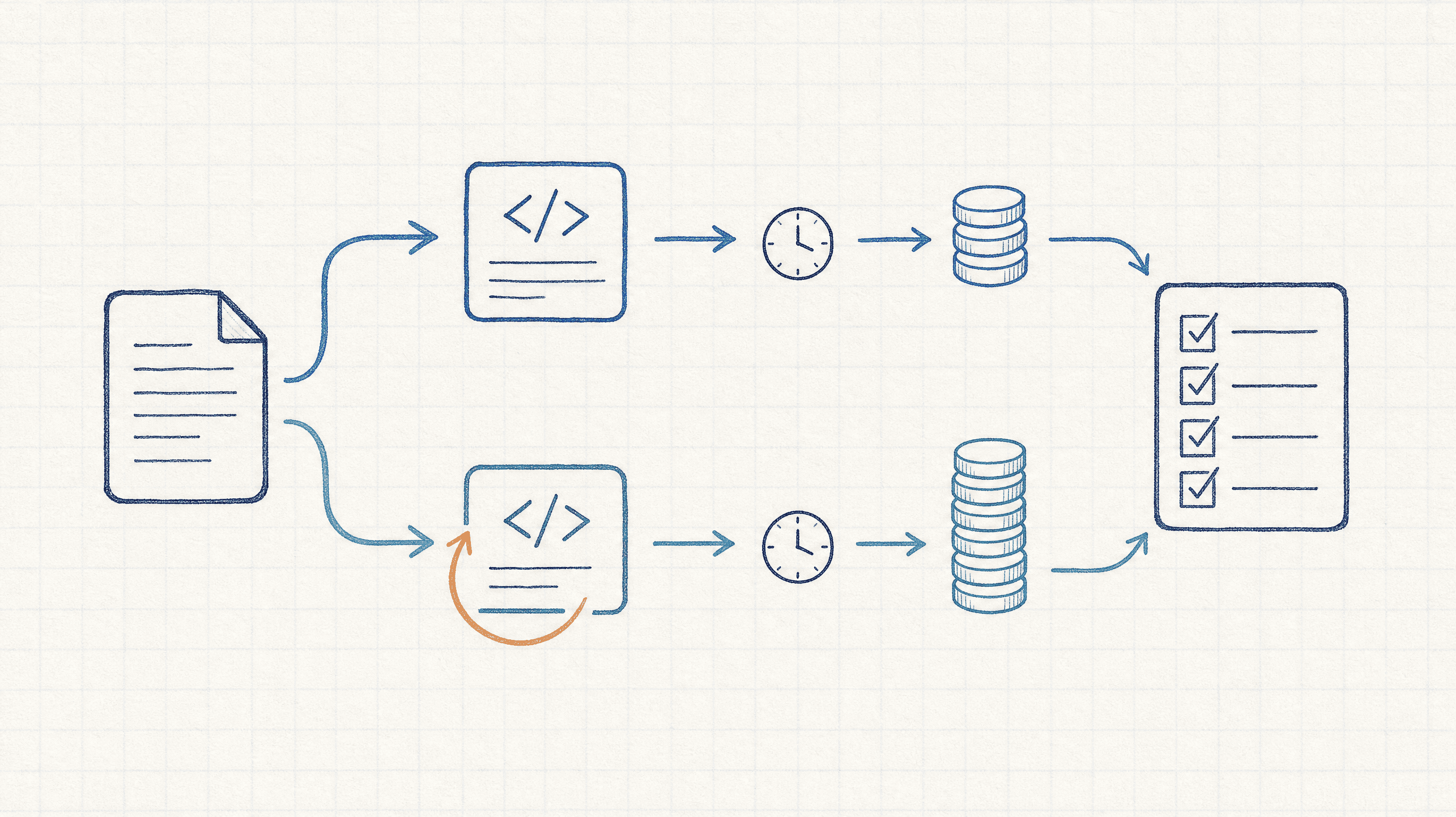
Prepare a reproduced bug, a cross-file change, and a task with images and text, and write the acceptance criteria first. Start each model from the same repository commit, a fresh session, and a separate working copy, and fix the accessible files, tools, permissions, time, and retry budget. You can run each three times to see the variance, but a sample this small isn't enough to infer a general success rate.
| Item | What to record |
|---|---|
| Correctness | Original tests, regression tests, interface compatibility, incorrect references |
| Change scope | Unrelated diffs, whether it went beyond the task boundary |
| Process | Tool errors, refusals, number of failures, whether you switched models |
| Cost | Input per turn, cache, billed output, and actual charges |
| Time | Total task time, manual review and fix time |
You can start both models at medium, but record their actual usage, and don't treat identically named levels as equal compute. List tests that raise effort, use fast mode, or change the channel separately.
Compare API cost as total cost of all attempts ÷ number of tasks that passed acceptance, and record manual fix time separately. If a set of tasks all fail, report it as a result that did not pass acceptance; don't record the cost of success as zero. For high-risk changes, also check whether errors were only caught after the tests, so you don't just record that a patch was generated.
Hands-on comparison: integration and pricing references
- You can compare the current channel prices for both models in the AI Code With model list, and for plans and top-up options, see the pricing page; for the different ways Codex bills, see “How Codex Pricing Works”.
- To test Opus 5.5 in Claude Code, first follow “Claude Code Third-Party API Setup Guide” to set the Base URL and Key, or see the Claude Code CLI docs.
- To test GPT-6.1 Sol in Codex, see “How to Configure a Codex API Key” for the setup.
- If you're only choosing between Anthropic models, see “Claude Sonnet 5.5 vs Opus 5.5”.
- If you don't have an account yet, first sign up for AI Code With, then use the same key to call both models and compare them.
Conclusion
If you already have a Responses tool chain and standard API cost matters, Sol is a reasonable place to start testing. If you already have a Claude tool loop or long-running tasks, Opus 5.5 is worth adding to the same set of regression tasks. Base the final choice on verifiable results and total cost, not on the model name or unit price.
Get the interface and acceptance checks working on one real task first, then widen the sample. Pay particular attention to Sol's 272K billing boundary, Opus's changes to thinking and tool choice, and the actual status of your target channel.
FAQ
Is GPT-6.1 Sol definitely better at coding than Opus 5.5?
This article did not run an independent head-to-head test under identical conditions. Official positioning, specs, or each model's own benchmark scores can't directly prove which one is stronger in your repository; you need to compare them on the same tasks, with the same tools and the same acceptance criteria.
Is Sol always half the price of Opus?
That's the case for the official standard-tier unit prices of regular input, output, and cache reads. Long context, fast mode, channel discounts, and actual usage change the cost ratio for the full task.
Can the medium settings of the two models be treated as equivalent?
Both are the default level in their respective APIs, but there is no evidence that they use the same amount of compute. When testing, explicitly record the settings and the billed usage.
Can I send the same tool-call request to a different model as is?
Don't assume it's compatible. Sol's tool interface uses Responses and Opus uses Messages, and their fields, tool loops, and return structures differ. Gateway compatibility has to be verified separately.
Does a low-price channel mean faster or more stable?
Price can't prove latency or availability. Check the channel's status at the time, then record time, failures, and cost with your own tasks; a single data point in the console can't replace a full test.
Sources and further reading
- GPT-6.1 Sol official model page: model capabilities, specs, reasoning levels, and billing boundaries.
- GPT-6 official usage guide: Responses and the conditions for using the current model.
- OpenAI API pricing: standard and long-context rates.
- Opus 5.5 official overview: specs, pricing, and default thinking behavior.
- Opus 5.5 official migration guide: parameter restrictions, tool choice, and response parsing.
- Anthropic API pricing: rules for caching, Batch, and long context.