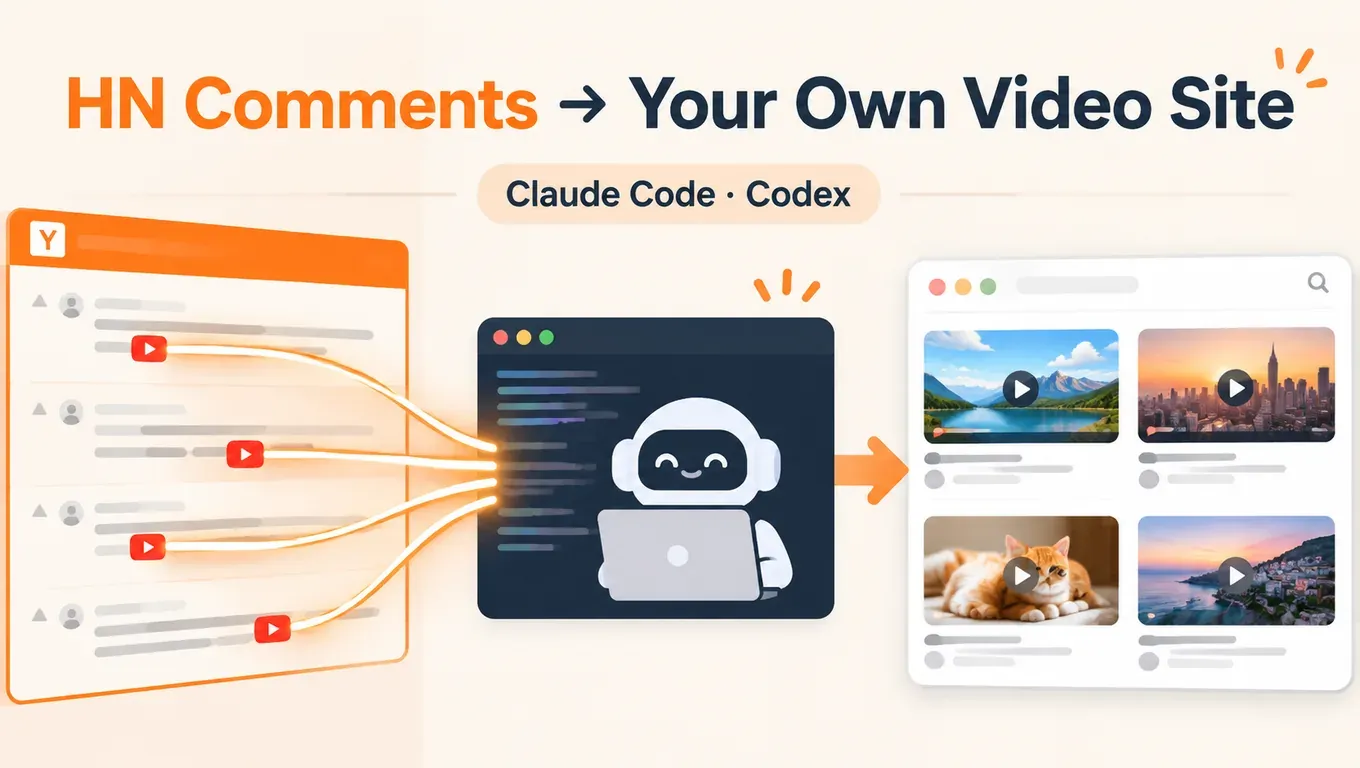
Short answer: the idea behind HackerTube is simple. Find every YouTube link ever posted in a Hacker News comment, keep only the videos that many different people recommended across many different months, and turn them into a video site with no login and no recommendation algorithm. With Claude Code or Codex, one prompt is enough to build a working mini version.
- According to Karpathy's original post (November 1, UTC), he was annoyed with YouTube's recommendations, so he had Claude filter about 43M comments from 20 years of HN down to 6,454 videos that keep being recommended. It took about two hours with the Claude Code desktop app and Opus 5.5 on Medium effort. His only manual work: creating a Google Cloud API key to query YouTube metadata, starting a VPS and buying the domain. As of the afternoon of November 2 (UTC+8), the post had about 3.3M views, 39.7K likes and 34K bookmarks.
- We had Claude Code and Codex each build a mini version with our API key, using the official HN Algolia API for September and October 2026. Both finished in about 9 minutes, both found about 3,600 comments with YouTube links and more than 3,500 distinct videos, both kept 193 videos linked by at least 2 different people, and the top 3 were identical.
- The gap between the mini version and HackerTube is judging whether a comment actually recommends the video. Ranking by link counts alone pushes news-of-the-week videos to the top: all 12 mentions of the number 3 video came from a single thread. The prompt for that missing step is near the end.
Create an API Key and build your own HackerTube in Claude Code, Codex or Cursor →
What HackerTube is and how Karpathy built it
HackerTube describes itself as "the YouTube videos that Hacker News keeps telling each other to watch". According to its about page, it currently lists 6,454 videos, based on 39,834 HN comments that mention them, sorted into 150 topics in 16 areas and spanning 2007 to 2026. Likes, history and Watch later live only in your own browser, there are no accounts, and thumbnails are a frame from the middle of the video instead of the uploader's optimized cover.
According to the "How it was built" section of the about page, it works in five steps:
| Step | What HackerTube does |
|---|---|
| 1. Read every comment | Scan a public archive of all of HN (the open-index/hacker-news dataset) for YouTube links, which turns up well over a hundred thousand videos |
| 2. Keep the repeat picks | At least 3 different people linked it with real commentary, in at least 3 different months; about 7,000 videos remain |
| 3. Read each comment with a model | Claude reads the comment with its story title and decides whether it recommends, cites, jokes about or criticizes the video, and picks a quote and topics |
| 4. Write a card per video | From YouTube details and everything HN said: a summary, why HN likes it, the type, and whether it has aged well |
| 5. Rank | By the number of distinct months people recommended it in; being linked again over the years beats one viral spike |
The about page also says the whole site, data pipeline, search and recommendations were built by Claude Opus 5.5 in Claude Code, and that the comment labels and video cards were written by Claude Sonnet 5.5 agents coordinated by Opus. The data is published too: the Data page offers a zip of about 17.8 MB with videos.jsonl, mentions.jsonl, the topic list, embeddings and a DATA.md written for agents, under ODC-By 1.0. Karpathy's suggestion in the post is to point your Claude at it and ask for your own version.
According to X trend summaries (one, two), people have already built follow-ups such as Hacker Papers for arXiv and lists of books and blogs.
What the mini version does
Rebuilding 20 years of data means downloading the full HN archive, which is too much for a first try. We narrowed it to two months and used only the official HN Algolia search API, which needs no key:
| Step | How | Output |
|---|---|---|
| 1. Fetch comments | Algolia search_by_date, tags=comment, split into time windows | data/comments.jsonl |
| 2. Extract links | Pull 11-character video ids from the comment text, covering watch?v=, youtu.be/, /shorts/ and others | Videos mentioned in each comment |
| 3. Count and dedupe | Mentions, distinct people and distinct months per video | Ranking |
| 4. Add titles | YouTube oEmbed, no key needed | data/videos.json |
| 5. Build the page | One static HTML file with a card grid and a client-side search box | site/index.html |
Step 1: Create an API Key and connect Claude Code or Codex
- Sign up at aicodewith.ai, log in, open Key management, create a key and copy the full string.
- Claude Code: set the base URL and key, create an empty folder and start it there:
export ANTHROPIC_BASE_URL="https://api.aicodewith.ai"
export ANTHROPIC_AUTH_TOKEN="YOUR_API_KEY"
mkdir -p ~/hackertube-mini && cd ~/hackertube-mini
claude --model claude-opus-5-5
To save the settings permanently or set them up on Windows, see How to connect Claude Code to a third-party API. Karpathy used Opus 5.5 on Medium effort; for choosing a level see Claude Opus 5.5 effort levels, and for a model comparison see Which model to use in Claude Code.
- Codex: put the following in
~/.codex/config.toml, with the key written directly inexperimental_bearer_token:
# ~/.codex/config.toml
model = "gpt-6.1-sol"
model_reasoning_effort = "medium"
model_provider = "aicodewith"

[model_providers.aicodewith]
name = "aicodewith"
base_url = "https://api.aicodewith.ai/chatgpt/v1"
wire_api = "responses"
experimental_bearer_token = "YOUR_API_KEY"
Every field is explained in Codex config.toml explained. If you are new to Codex, start with How to use Codex and How to install Codex.
Step 2: Look at the HN Algolia API yourself first
Run one request before you start so you know what the data looks like. This one asks for comments posted on 2026-09-01 that contain youtu (it matches both youtube.com and youtu.be):
# comments posted on 2026-09-01 (UTC) that contain "youtu"
curl "https://hn.algolia.com/api/v1/search_by_date?query=youtu&tags=comment&hitsPerPage=1000&numericFilters=created_at_i>=1788220800,created_at_i<1788307200"
In our test, HN had 10,830 comments that day and 197 of them contained youtu. Two limits matter:
- Each query returns at most 1000 hits. Over two months,
youtube.comalone matches more than 4,000 comments and the rest are cut off, so the time range has to be split into small windows. - Searching for
youtubemisses short links.youtu.be/xxxxdoesn't contain the wordyoutube. Search for theyoutuprefix and match exactly with a regex locally.
We put both points in the prompt, and both Claude Code and Codex still tested the requests and confirmed the limit before writing the pipeline.
Step 3: Give the prompt to the agent
Save the text below as prompt.txt and give it to Claude Code or Codex. This is exactly what we used:
Build a mini "HackerTube" in this folder: a static site of the YouTube videos that Hacker News commenters keep recommending to each other.
1. Fetch data only from the official HN Algolia API (https://hn.algolia.com/api/v1/search_by_date, tags=comment). Take every comment created from 2026-09-01 00:00 UTC to 2026-10-31 23:59 UTC that contains a YouTube link (youtube.com/watch, youtu.be/, /embed/, /shorts/, m.youtube.com, music.youtube.com). Note the API returns at most 1000 hits per query, so split the time range into small enough windows. Be polite: at most 2 requests per second. Save raw hits to data/comments.jsonl.
2. Extract and normalize the 11-character video ids (HTML-unescape the comment text first), and drop the commenter's own repeated links within the same comment.
3. For each video count: mentions, distinct commenters, distinct months, first and last mention, and keep up to 3 short quotes with links to the HN comment (https://news.ycombinator.com/item?id=...). Keep a video only if at least 2 different people linked it. Rank by distinct commenters, then mentions.
4. Get titles for the kept videos from YouTube oEmbed (https://www.youtube.com/oembed?url=...&format=json, no API key); if oEmbed fails keep the id and mark it unavailable. Save data/videos.json.
5. Generate site/index.html: a single static page, no login and no tracking, with a grid of cards (thumbnail from https://i.ytimg.com/vi/<id>/hqdefault.jpg, title, channel, "N people / M mentions", one quote) and a client-side text filter.
6. Write the whole pipeline as a reusable script build.py (stdlib only, with a --since/--until option) and run it. Finally reply with: total comments fetched, unique videos found, videos kept, the top 10 videos (id, title, people, mentions), and any problems you hit.
Three things in this prompt matter: naming the official API as the only data source keeps the agent from scraping web pages; stating the 1000-hit limit and the request rate up front keeps it from discovering missing data halfway through; and asking for a rerunnable build.py means a new time range or threshold doesn't need a new conversation.
To run it in the background, use non-interactive mode. Claude Code's --allowedTools allows only the commands this job needs. Codex's default sandbox has no network access, so we used --sandbox danger-full-access in a dedicated empty folder; that permission is broad, so don't use it in a folder with important files. See Codex automation permissions for the options:
# Claude Code, non-interactive: only allow the commands this job needs
cat prompt.txt | claude -p --model claude-opus-5-5 \
  --permission-mode acceptEdits \
  --allowedTools "Bash(python3:*)" "Bash(curl:*)" "Bash(ls:*)" "Bash(mkdir:*)" "Bash(head:*)" "Bash(wc:*)"

# Codex, non-interactive (reads the prompt from stdin)
codex exec --skip-git-repo-check --sandbox danger-full-access - < prompt.txt
Test: Claude Code and Codex with our API key
Both clients got the same prompt and ran at the same time on the same Linux machine on the afternoon of November 2, 2026:
| Claude Code 2.1.316 + Opus 5.5 | Codex 0.166.0 + GPT-6.1 Sol | |
|---|---|---|
| Time | About 555 seconds, 21 turns | About 534 seconds, 30 commands run |
| How it fetched | Daily windows searching youtu, splitting any window over 1000 hits in half; 61 requests | 61 daily windows searching youtu, checking that none reached 1000 |
| Comments with YouTube links | 3,624 | 3,619 |
| Distinct videos | 3,511 | 3,505 |
| Kept (2 or more people) | 193 | 193 |
| No title found | 2 (oEmbed returned 403 and 401) | Same |
| Self-checks | Compared against a full scan of one day; both found the same 87 comments with links | Wrote 5 tests and opened the page in headless Chrome to check the cards and the search box |
| Output | build.py 418 lines, index.html about 258 KB | build.py 258 lines, index.html about 210 KB |
Both clients chose the same approach on their own: instead of scanning every comment (about 600,000 in two months), they searched each day for youtu and matched exactly locally. Claude Code also verified that shortcut: a full scan of September 1 gave exactly the same result as the prefilter, and it noted that searching for youtube would have missed 20 comments with short links.
The top 10 was almost the same on both sides and the top 3 were identical. We also counted how many mentions of each video came from a single thread:
| Rank | Video | People | Mentions | Months | Most in one thread |
|---|---|---|---|---|---|
| 1 | 216,000,000 Spy TVs – The LG Smart TV Problem | 15 | 18 | 2 | 7 |
| 2 | Kernel Recipes 2026 - Security in the LLM age | 12 | 21 | 1 | 2 |
| 3 | The FLYING Tesla Roadster explained by the man who engineered it | 11 | 12 | 1 | 12 |
| 4 | LG Says We're Fake News | 6 | 7 | 1 | 6 |
| 5 | Reinventing Entropy – Compression is Intelligence Part 1 | 6 | 6 | 2 | 3 |
Each video in data/videos.json looks like this, with quotes linking back to the original HN comment:
{
  "id": "6IFVTcM28KA",
  "title": "216,000,000 Spy TVs | The LG Smart TV Problem",
  "people": 15, "mentions": 18, "months": 2,
  "first_mention": "2026-09-07T10:52:26Z",
  "last_mention": "2026-10-13T16:41:11Z",
  "quotes": [
    {"author": "wavesplash", "date": "2026-09-07",
     "url": "https://news.ycombinator.com/item?id=49597752",
     "text": "... Worth a watch to see how bad this is"}
  ]
}
The generated build.py can be rerun with a different time range or threshold (Claude Code's version shown):
python3 build.py --since 2026-09-01 --until 2026-10-31   # full run
python3 build.py --skip-fetch --min-people 3              # rebuild from saved comments with a stricter rule
python3 build.py --full-scan                              # scan every comment instead of the "youtu" prefilter (slow)
Three problems the test turned up
- Ranking by link counts treats news of the week as a classic. All 12 mentions of the number 3 video came from one thread discussing that video, and 6 mentions of the number 4 video came from one thread too. That is exactly why HackerTube requires at least 3 different months and has a model judge each comment. In our two months of data, only 22 videos had at least 3 people and at least 2 months.
- People often paste broken URLs, and the two clients handled them differently. Claude Code kept 5 more comments than Codex, all with URLs like the ones below. Claude Code took the first 11 characters and kept them; Codex parsed them as standard URLs and dropped them. The third one actually has two extra characters, so taking the first 11 may point to the wrong video:
https://www.youtube.com/watch?v=sCr_gb8rdEI?t=11m     <- "?" instead of "&"
https://youtu.be/69o-8Mtd3Kc&t=330                    <- "&" instead of "?"
https://www.youtube.com/watch?v=909o_kbCdFgll         <- 13 characters, not 11
- oEmbed doesn't return a title for every video. 2 of the 193 kept videos returned 403 or 401, most likely private or with embedding disabled; both clients marked them unavailable and showed only the id. For duration, view counts and similar details you need a YouTube Data API key from Google Cloud, as Karpathy did.
From the mini version to HackerTube
First, have a model judge each comment. This makes the biggest difference. In the mini version's folder, tell the agent:
For each comment in data/comments.jsonl, read the comment text and the HN story title,
and label what the commenter does with the video: strong_rec, rec, reference, joke or critical.
Write the labels to data/stance.jsonl. Then only count strong_rec and rec,
keep a video if at least 3 different people recommended it in at least 3 different months,
and rank by the number of distinct months. Rebuild site/index.html.
Judging thousands of comments one by one is slow, so let the agent split them into parallel batches. Running too many Codex tasks at once can hit 429 errors; see How to fix Codex 429 Too Many Requests for controlling concurrency.
Second, use more data. Algolia is good for fetching by time range; to cover 2007 to today, the open-index/hacker-news archive mentioned on HackerTube's about page is a better fit. The easiest route is to download HackerTube's data zip, have the agent read DATA.md first, and then change the interface or ranking to your taste.
Third, deploy it. The mini version is a static page that opens on any static host. According to Karpathy's post, he gave Claude the VPS IP and told it to update, secure, harden, deploy and optimize, and Claude did the whole thing.
Common questions
Algolia returns fewer hits than nbHits
Each query returns at most 1000 hits; nbHits is only the total. Make the time windows smaller until every window has fewer than 1000 hits. Daily windows were enough for us, and busy days can be split in half again.
Why searching for youtube misses links
Short youtu.be links don't contain youtube. Search for youtu, then filter locally with a regex for watch?v=, youtu.be/, /embed/, /shorts/ and similar forms.
Links in comments look like /
Algolia returns comment_text HTML-escaped: / becomes / and & becomes &. Unescape the HTML before extracting links or the regex won't match anything. Item 2 of our prompt says this explicitly.
Doing the same for papers, books or podcasts
Replace YouTube in the prompt with arxiv.org/abs/, amazon.com/dp/ or podcast links; the counting and page logic can stay the same. For reading papers afterwards, see Search and read arXiv papers with Claude Code.
Making the agent follow the same rules every time
Put the data source, thresholds and page requirements in the project's CLAUDE.md or AGENTS.md; see How to write CLAUDE.md for Claude Code.
Summary
HackerTube shows that small products that "filter content by other people's taste" are now a one-person job with a coding agent. In our test, scraping Hacker News comments with Claude Code or Codex, extracting YouTube links and producing a usable static video site took about 9 minutes. What really decides the quality is the rule for what counts as a recommendation, and whether the time span is long enough.
Create an API Key and start building in Claude Code, Codex or Cursor →